AI watermarking, explained: what it is and what Anthropic just shipped
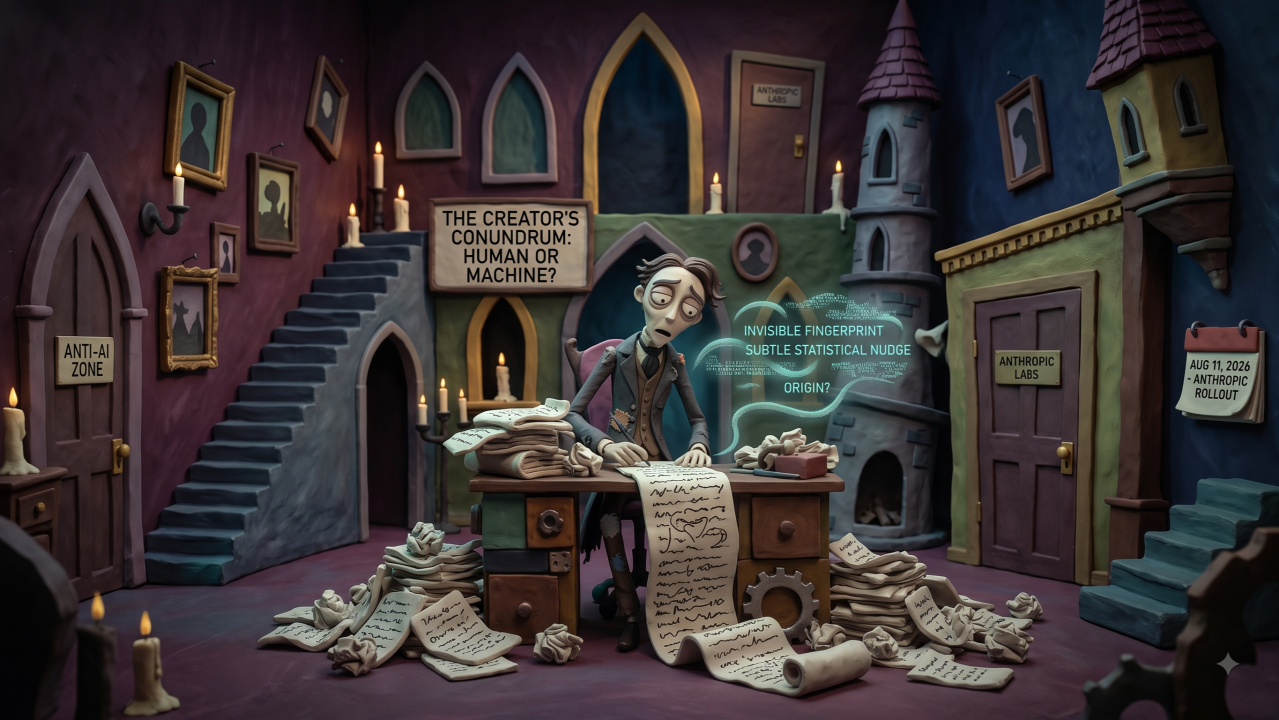
AI generated text is now in email, articles, homework, and code. That creates a practical problem for anyone who has to judge provenance: how do you tell what a machine wrote from what a person wrote? Watermarking is the industry’s leading answer, and this week Anthropic became the first major AI lab to deploy it at scale for text.
What AI watermarking actually is
AI watermarking embeds a hidden, machine-readable signal into content a model generates. For text, that is not a visible stamp or a footer. It is a statistical pattern woven into the writing itself, invisible to a human reader and detectable by software built for the purpose. For images, audio, and video, watermarking usually means a signal embedded in the pixels, the waveform, or the file metadata.
The text technique works by biasing which words a model picks during generation. At each step, a language model has many statistically likely next words available. A watermarking system nudges it toward a particular subset of those words, still coherent and still natural, in a pattern a detector can recognize later. Done well it does not change quality or meaning. It leaves a fingerprint.
That fingerprint is fragile. Heavy editing, paraphrasing, translation, or a pass through another model can weaken it or erase it. No provider claims its watermark is durable against a determined rewrite.
How other labs handle it
Google reached production first. Its SynthID system, built by Google DeepMind, embeds watermarks across Gemini’s text, image, audio, and video outputs, and Google has open-sourced the text version for other developers. Google says SynthID has labeled more than 100 billion pieces of content.
OpenAI has moved more slowly. In May 2026 it began embedding Google’s SynthID watermark into ChatGPT generated images, joining Nvidia and others around that standard. For text, the hardest content type to watermark because it is endlessly copied, cut apart, and rewritten, OpenAI has said it studied the approach without shipping a production watermark.
Regulation is driving most of this. Article 50 of the EU AI Act, in effect since August 2, 2026, requires AI providers to embed machine-readable markings in generated content where technically feasible. It does not mandate a specific technology. That deadline is why several labs are describing their compliance approach at the same time, per Axios.
What Anthropic announced
On August 11, 2026, Anthropic confirmed that Claude models launched on or after August 2 embed an invisible statistical watermark in generated text, and that it applies worldwide rather than only in the EU, according to TechCrunch. That makes Anthropic the first frontier lab to turn on text watermarking across all of its products at once instead of piloting it on one surface.
The coverage is broad. The watermark applies across the Claude platform API, claude.ai, Claude Code, Claude Cowork, Claude Tag, and Claude accessed through AWS, Google Cloud, and Microsoft Foundry. Generated files such as images get a different treatment: signed metadata confirming Claude processed the asset and indicating whether it has been altered since.
Per Fortune, Anthropic says the text mark survives copy and paste and some light editing, but a heavy rewrite or a translation can remove it. Anthropic has also been direct about what the mark does not prove. It signals that Claude touched the content somewhere. It does not signal that Claude wrote it. Asking Claude to proofread or translate a human-written paragraph can leave the same trace, a limit CNN also noted.
Reaction has split along that ambiguity. Some users read the mark as honest disclosure that AI was involved. Others read it as the model quietly claiming credit for work it only partly produced, a reaction Forbes documented after the announcement.
What it means in practice
There is no public detector yet. Anthropic has not shipped the tool to check whether a given passage carries its watermark, though the company says one is coming. Until it does, users are operating under a new default they cannot see, control, or strip through normal editing, tied to a compliance regime that now applies globally rather than only in Europe.
That is a meaningful shift in what provenance means for text. Not proof of authorship, and not a forensic guarantee, but a signal that a model was in the loop somewhere, attached to the output by default and readable only by whoever holds the detector.