Not All Tokens Are Created Equal
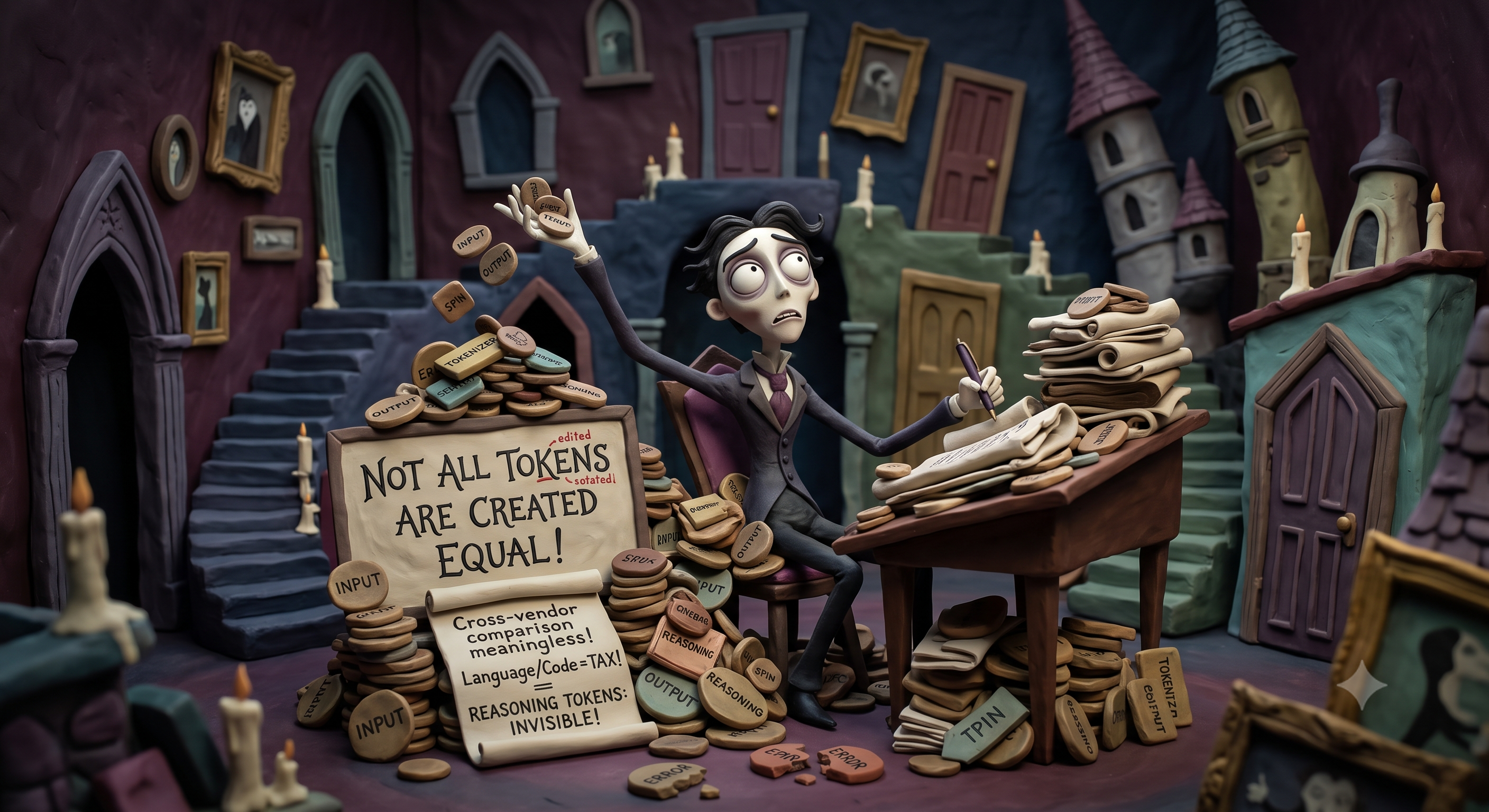
The token has become the unit of account for enterprise AI. It is a bad one.
Nufar Gaspar made that case on The AI Daily Brief with Nathaniel Whittemore on 2 August 2026. Her framing is the most useful one available right now: stop reading the bill in tokens and start reading it in dollars per accepted task. Tokens are an unmeterable moving target. Accepted work is not.
Three things make the token unreliable as a measure. The tokenizer. The language. The code.
The tokenizer sets the price, not the price sheet
A token is a chunk of text, larger than a character and smaller than a word. In English the ratio runs around three quarters of a word per token, so a page of prose costs roughly 1,000 tokens.
That ratio is not universal. Every lab ships its own tokenizer. OpenAI’s vocabulary sits near 200,000. Gemini’s is around 256,000. Llama’s is about half. Anthropic does not publish its own. Price per million is denominated in each vendor’s tokens, which means the same document can cost 10 to 20 percent more on one provider than another at identical sticker prices. Cross-vendor comparison on published rates alone is meaningless.
Opus 4.7 demonstrated the sharper version of this in April. The per-million price sheet did not change. The tokenizer did, and it produced roughly 30 percent more tokens for the same text. Independent analysis across more than a million requests found native token counts up 32 to 45 percent, with real bills up 12 to 27 percent after caching. Same sticker, smaller candy bar.
The tokenizer also explains a class of failure we have been misreading. Models miscount the letters in “strawberry” because they never saw letters. They saw “straw” and “berry.” Most of the AI-is-dumb memes are tokenization artifacts, not reasoning gaps.
Language and code carry a tax
Because billing is per token, non-English work costs more for identical content. Hindi, Thai, and Greek can generate two to five times the tokens for the same meaning. The question is the same. The invoice is not.
Code has its own overhead. Indentation, brackets, and whitespace all tokenize. A verbose codebase is a more expensive codebase before a single model call does anything useful.
The bill has three layers, and one is invisible
Input tokens cover the prompt, conversation history, uploaded files, and tool definitions. They are the cheapest layer and they accumulate fastest.
Reasoning tokens are the model’s internal thinking. We never see them. They bill at the high output rate and can add four to twenty times the volume. This is the layer that surprises people. It is where budgets break.
Output tokens are what appears on screen, typically three to five times the input rate. On GPT-5-class pricing that gap runs $10 per million input against $50 output.
Two compounding effects sit on top. Conversations resend the full session on every turn, so cost grows faster than turn count suggests. Agentic work runs five to thirty times a simple chat, because a single task means ten to twenty model calls carrying instructions, history, tool definitions, and prior results. McKinsey attributes around 60 percent of an agentic task’s cost to checking, refining, and regenerating. The expensive part is not the answer. It is getting from the answer to something accepted.
Spin is the money nobody budgeted
Gaspar’s own example makes the cost concrete. She disabled a chief-of-staff agent, travelled, and still received a $1,500 bill over two weeks. Roughly 400 million tokens in, near zero out, a ratio around 2,600 to 1, generated by cron jobs compacting empty sessions every thirty minutes.
Whittemore’s addition matters as much. Spin is not only error. He ran an agent perpetually researching AI adoption data sources. It did exactly what it was told. It simply stopped being worth the cost. The audit target is not just broken automation. It is automation that quietly became worthless. Hourly Slack miners. A morning brief nobody opens.
The usual suspects are idle or over-frequent agents, unused automations, always-on rules and tool definitions, immortal sessions, unfiltered retrieval, and rework loops. The diagnostics are simple. Run the weekend test. Look for extreme input-to-output ratios. Watch for spend rising while value stays flat.
What to measure instead
Cost per accepted task. Include retries, review time, and every correction, then divide by accepted results.
That metric produces counterintuitive answers. Databricks tested coding agents against its own codebase. Sonnet 5 was 1.7 times cheaper per token than Opus 4.8 and cost more per task, $2.09 against $1.94, because it needed more iterations. The cheaper model was the more expensive operation. Reach for the right model, not the cheap one.
The practical audit takes an afternoon. Run five to ten representative tasks across your model and tool options, hold input and quality constant, and compare first-pass success, human correction, elapsed time, and total cost.
Then sort tokens into three buckets. Tokens that spin. Tokens that produce. Tokens that teach. Kill the spin, tune production, defend teaching, in that order. According to the AI Daily Brief, a study of 20,000 developers found the heaviest AI users were roughly twice as productive. Cutting indiscriminately cuts that.
Gaspar’s closing point is the one to hold onto. The most expensive token is the one your best person is afraid to spend.