Part 5: The Future is Collaborative
Day 5 of a 5-part series: What I Learned About Building the Future
Missed an installment in the series? Here is Part 1, Part 2, Part 3, and Part 4
Here we are, five days and one complete development journey later. What started as a simple idea—building a better newsletter platform—turned into something much more significant: a glimpse into the future of how humans and AI can work together to create things that neither could build alone.
As I write this final installment, the weekly Friday Wrap Up is ready for it’s weekly release and my AI Agent coded Friday Wrap Up web app is live. The AI content analysis has been processing dozens of cybersecurity articles each day.
But the real story isn’t the platform I had the AI Agent build—it’s what I learned about collaboration, creativity, and the future of work.
The Collaboration Model That Changed Everything
When I started this project, I thought AI would be a powerful tool—like a really smart search engine or an advanced code generator. What I discovered was something fundamentally different: a genuine collaboration partner.
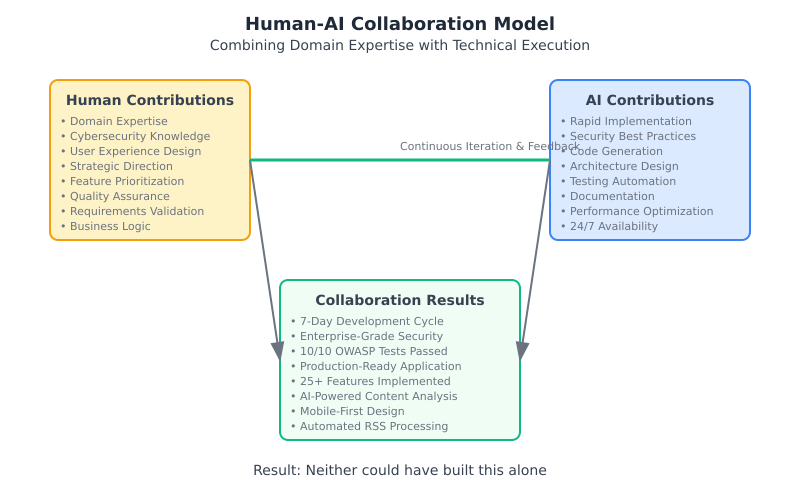
What Human-AI Collaboration Actually Looks Like:
Human Contributions:
Domain expertise and industry knowledge
User experience intuition and design thinking
Strategic decision-making and priority setting
Quality assurance and requirements validation
Business logic and stakeholder management
AI Contributions:
Rapid technical implementation and code generation
Security best practices knowledge
Architectural design and system optimization
24/7 availability for iteration and refinement
Access to vast technical knowledge and patterns
The Magic Happens in the Overlap:
Real-time problem-solving and solution iteration
Immediate feedback loops between concept and implementation
Continuous testing and refinement of ideas
Rapid prototyping that enables true experimentation
Three Paradigm Shifts That Surprised Me
1. From Sequential to Parallel Development
Traditional development: Plan → Design → Build → Test → Deploy → Learn
AI-Collaborative development: Plan/Design/Build/Test/Deploy/Learn all happening simultaneously
I could test ideas while implementing them, adjust architecture while building features, and deploy improvements while gathering user feedback aka me pretending to a real world user. The entire development lifecycle became fluid and continuous.
2. From Risk Aversion to Experimental Confidence
When the cost of trying something is 30 minutes instead of 30 hours, you can afford to be more experimental. I tested features, that might have not been attempted in traditional development, because the investment was so low.
This led to innovations I never would have discovered through planning alone—like the AI threat severity scoring that became one of my most valuable features.
3. From Documentation to Conversation
Instead of writing extensive technical documentation to communicate requirements, I could have real-time conversations about implementation. The AI understood context, remembered previous decisions, and could suggest improvements based on the entire project history.
This conversational development felt more like working with a really smart colleague than using a tool.
The Unexpected Benefits
Development Velocity: Obviously, the AI Agent built faster than a human. But did it build better? It did enabled iteration that’s impossible with traditional timelines.
Security by Default: Having an AI partner with security knowledge meant I implemented best practices consistently, not just when I remembered to look them up.
Learning Acceleration: I learned more about modern web development, security implementation, and system architecture in one week than I had in the previous year of casual learning.
Creative Confidence: Knowing I could rapidly implement and test ideas made me more creative in proposing solutions. When “what if we tried…” doesn’t cost three days of work, you ask it more often.
What This Means for the Future of Work
This project gave me a preview of what I believe will become the standard approach to complex problem-solving across many industries:
Enhanced Human Expertise: AI doesn’t replace domain expertise—it amplifies it. My cybersecurity knowledge became more valuable because I could rapidly implement solutions based on that knowledge.
Democratized Technical Skills: Complex technical implementation became accessible without years of specialized training. But domain knowledge and strategic thinking became even more important.
Accelerated Innovation Cycles: The ability to move from idea to working prototype to production-ready solution in days instead of months changes what’s possible for individual creators and small teams.
New Collaboration Models: Human-AI teams can tackle problems that were previously impossible for small teams to address—like building enterprise-grade security systems (maybe) or implementing sophisticated AI analysis.
The Friday Wrap Up Success Story
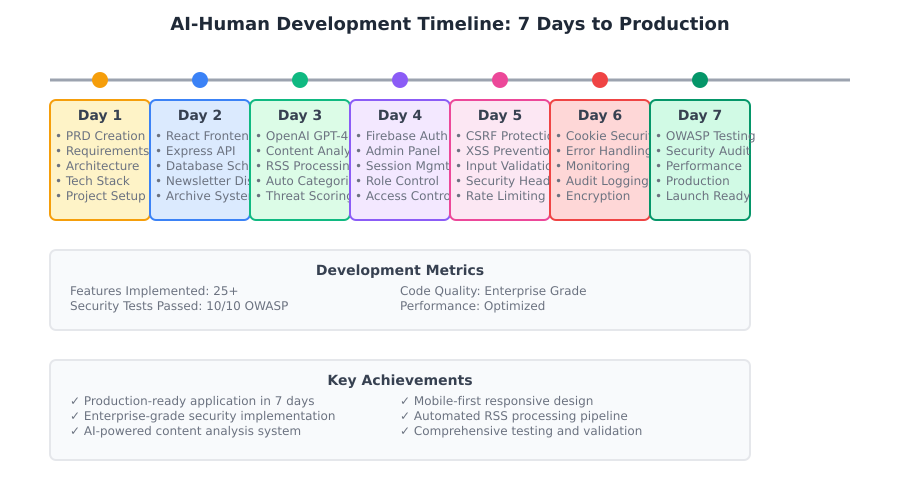
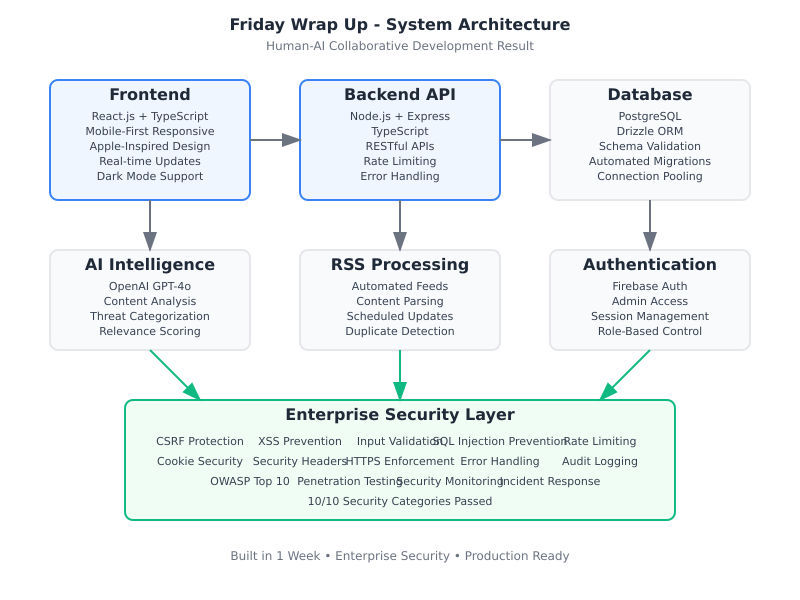
Let me share what I actually accomplished in my one week of collaboration:
Technical Achievements:
Production-ready web application
Enterprise-grade security that passed comprehensive OWASP testing
AI-powered content analysis and threat categorization
Mobile-first responsive design with excellent UX
Automated RSS processing pipeline
Comprehensive admin dashboard and analytics, even if no one else but me get to see and use it
Business Impact:
Increased content quality through AI-assisted analysis
Improved user engagement with better mobile experience
Established platform for future cybersecurity content initiatives
Personal Learning:
Modern web development patterns and best practices
Advanced security implementation techniques
AI integration strategies and optimization
User experience design principles
Product management and iteration strategies
Lessons That Apply Beyond Development
1. Clarity of Vision Multiplies AI Effectiveness The better I could articulate what I wanted to achieve and why, the more effectively the AI could contribute solutions. This applies to any human-AI collaboration—clear communication and well-defined objectives are multipliers.
2. Human Judgment Remains Essential AI can implement features rapidly, but humans need to decide which features actually matter. I built and removed several technically impressive features that didn’t solve real user problems. Strategic thinking and user empathy remain uniquely human skills.
3. Iteration Speed Changes Decision-Making When you can test ideas quickly, you can make decisions based on real data rather than extensive planning. This bias toward experimentation over analysis could revolutionize how we approach problem-solving in many fields.
4. Compound Learning Effects Each solved problem became the foundation for more sophisticated solutions. The AI remembered our entire development history and could suggest improvements based on patterns that emerged over time. This compound learning effect accelerated throughout the project.
The Bigger Picture: What We’re Really Building
This project wasn’t just about creating a newsletter platform—it was about learning a new model for how humans (me) and AI can collaborate to solve complex problems.
I demonstrated that:
Small teams (even teams of one + AI) can build enterprise-grade solutions
Security-first development doesn’t have to slow down innovation
Complex technical projects can be accessible to domain experts without deep technical backgrounds
Rapid iteration enables better outcomes than extensive upfront planning
Human creativity combined with AI execution creates possibilities neither could achieve alone
The Tools Are Ready. Are We?
The technology for this kind of collaboration exists today. AI coding assistants, cloud infrastructure, modern development frameworks—all the pieces are in place for individuals and small teams to build solutions that previously required large development teams.
The limiting factor isn’t technology—it’s imagination and willingness to experiment with new ways of working.
An Invitation to Experiment
If our journey has inspired you to try AI-powered development, here’s how to start:
Begin with a Clear Vision Write a detailed PRD that captures what you want to build and why. Be specific about user problems, not just features.
Think Security First Build protection into your architecture from the beginning. It’s much easier to secure systems during development than to retrofit security later.
Embrace Rapid Iteration Use AI’s speed to test ideas quickly and fail fast when needed. Don’t be afraid to remove features that don’t work.
Stay Hands-On Review every feature, test every assumption, and guide the technical decisions. AI amplifies human judgment—it doesn’t replace it.
The Friday Wrap Up Launch
As I finish writing this series, I’m excited to announce that Friday Wrap Up is now live and ready for the cybersecurity community. You can find it at fridaywrapup.site, where it continues to serve weekly cybersecurity intelligence with AI-powered analysis and enterprise-grade security (fingers crossed).
But more than just launching a platform, I’ve proven something important: the future of software development isn’t human versus AI—it’s human with AI. Together, we can build better applications faster than ever before.
A Personal Reflection
Today, I have an intelligent platform that automatically processes cybersecurity intelligence, categorizes threats, and presents everything in a beautiful, secure interface.
But the real transformation wasn’t the platform—it was discovering a new way to bring ideas to life. For the first time, the speed of implementation could match the speed of creativity. That’s a powerful feeling.
What Will You Build?
The tools exist. The collaboration models work. The only remaining question is: what will you create with your AI partner?
Whether you’re a cybersecurity professional with ideas for better threat intelligence, a marketer who envisions a smarter content platform, or an entrepreneur with a solution that could change your industry—the barriers to bringing those ideas to life have never been lower.
The future is collaborative. And it starts with your next project.
Thank You for Following Along
This five-part series documented a real journey—the successes, the pivots, and the moments of breakthrough. I hope it’s inspired you to think differently about what’s possible when human creativity meets AI capability.
The Friday Wrap Up platform is now live and accepting subscribers. Visit fridaywrapup.site to experience AI-powered cybersecurity intelligence delivered with enterprise-grade security and mobile-first design.
This concludes my 5-part series on building my Friday Wrap Up web app through human-AI collaboration. Each installment explored a different aspect of the development journey, from initial vision to production launch. The complete series is soon be available as a PDF download for those who want to reference the full development process.